Module 01 · eleven agents
Close & review
- Close review agentLive
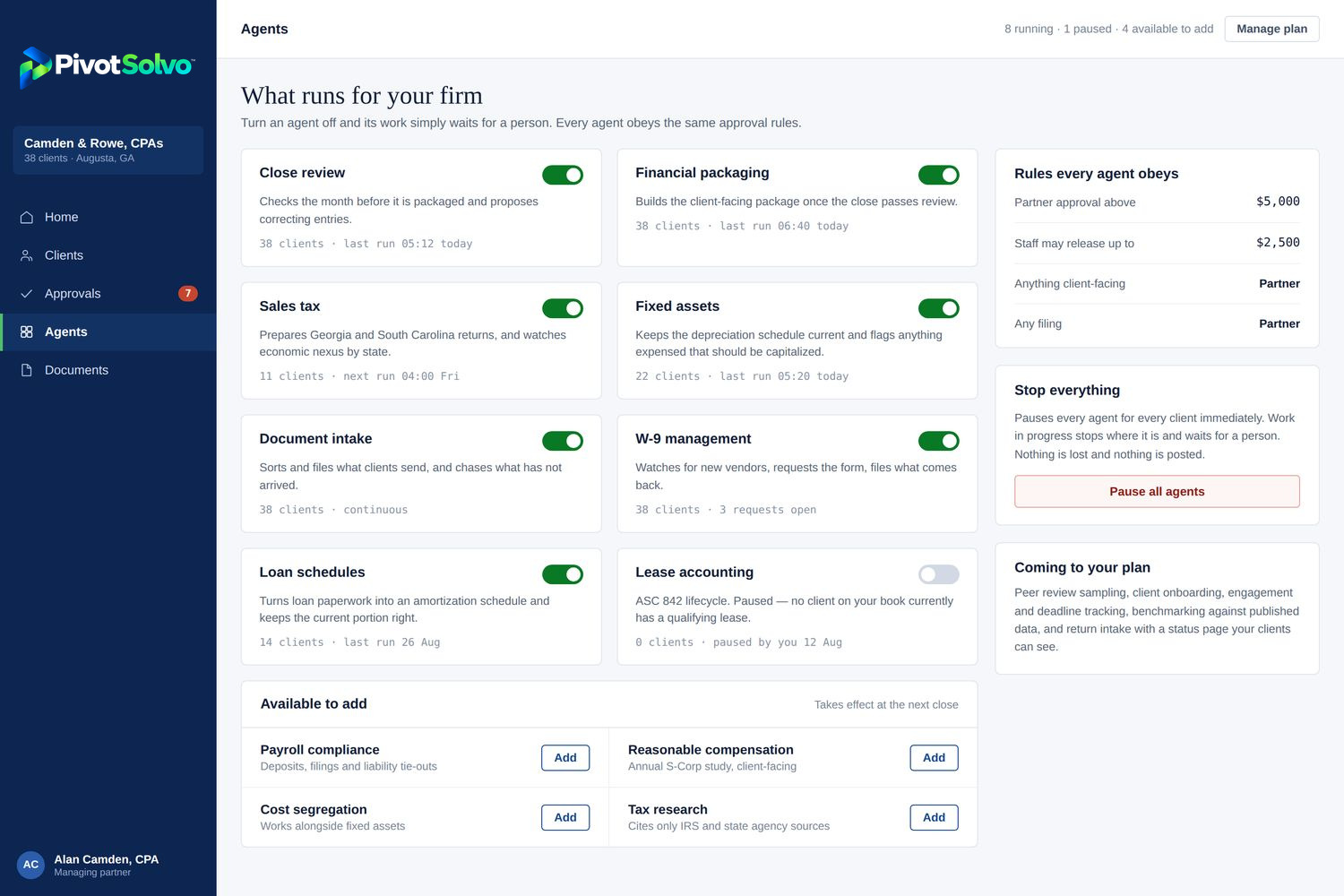
Runs the full month-end review on the client's own tax basis — reconciliations, balance-sheet tie-outs, variance work against prior periods, and a memo. Produces findings with the underlying transactions attached, proposed adjusting entries, how-to-fix steps, and the questions that need to go to the client. Findings it proposes go to a named reviewer, and once approved they pass to the write-back agent below.
- Write-back & approval agentIn build
Carries an approved entry into the accounting system against the named person who approved it, dates and links reversing entries automatically, blocks closed periods and duplicates, then reads the entry back to verify it landed. It sits between close review and financial packaging: nothing is packaged until the approved entries have been written back and the adjusted numbers re-pulled.
- Financial packaging agentLive
Turns the closed, adjusted numbers into a client-ready financial package under the subscribing firm's own branding — compilation letter, statements, comparatives, and any open items disclosed rather than hidden. The compilation report itself needs a CPA to sign, so firms without one get a non-report variant of the package. It builds from the adjusted numbers after write-back is verified, never from the draft.
- Peer review agentRoadmapCredentialed
Reviews the firm's own completed work the way a peer reviewer would, ahead of the real one.
- Bank feed agentRoadmap
Categorizes bank transactions against the client's own history and prepares the reconciliation for review.
- Catch-up & cleanup agentRoadmap
Works through backlogged books in batches of a size a person can actually review, oldest period first.
- Job costing agentRoadmap
Crew and job costs for service and construction clients, tied back to the ledger.
- Fraud & anomaly watch agentRoadmap
Flags unusual transactions and patterns, with the evidence, for a person to look at. It never accuses and never acts.
- Multi-entity consolidation agentRoadmap
Combines related entities into one set of statements, with intercompany items eliminated and shown.
- Review engagement support agentRoadmapCredentialed
Supports review-level work. The review report itself is signed by a CPA.
- Audit & workpaper support agentRoadmapCredentialed
Organizes workpapers and supporting documents. CPA only.
Module 02 · three agents
Schedules
- Fixed asset & depreciation agentIn build
Owns the depreciation schedule as its engine. Scans Repairs & Maintenance and Office Supplies each period for spend that looks capital in nature, asks the client directly whether anything was bought, sold or disposed of, flags Section 179 and bonus elections for confirmation, and extends to intangible amortization, prepaids and deferred revenue.
- Loan & amortization agentIn build
Builds the schedule from the note itself, solving the rate when it is not stated. Catches the whole payment booked to an expense account, matches payee names against known finance companies, splits interest from principal, applies genuine extra principal to the balance, and asks before assuming a loan was paid off.
- Lease accounting agentIn build
The full ASC 842 lifecycle — classification, initial ROU asset and liability measurement, the ongoing schedule, and monitoring for modifications, renewals and impairment. If lease accounting is on the books with no paperwork on file, it asks rather than guesses. Classification always goes to a person.
Module 03 · nine agents
Compliance
- Sales tax & nexus agentIn build
Reads the firm's own filing tracker as source of truth for jurisdictions, frequency and due dates, ingests point-of-sale reports where the ledger alone will not do, reconciles the liability as part of the close rather than as a separate chore, and tracks economic nexus thresholds by state.
- Payroll compliance agentRoadmap
Deposit deadlines, worker classification, multi-state withholding, and the W-2 and 1099 calendar.
- W-9 management agentIn build
Watches the ledger for vendors it has not seen before, requests the W-9 from the vendor directly rather than routing it through the client, and files the returned form to the portal.
- Deadline & engagement tracking agentIn build
Every compliance date across every entity type in the book, held in one place, with the work backed up from the deadline rather than forward from whenever someone remembered.
- Information returns agentRoadmap
Prepares 1099 and W-2 reporting from the books and ties it to payroll at year end. A person approves; nothing is filed automatically.
- Entity compliance agentRoadmap
Tracks annual reports, registrations and renewals for each client entity.
- Multi-state nexus agentRoadmapCredentialed
Maps where a client has income tax filing obligations, for a signer to review.
- IRS notices & representation agentRoadmapCredentialed
Organizes a notice response for the authorized representative to review. Nothing is sent without that person.
- Estimated tax agentRoadmapCredentialed
Safe-harbor and estimated payment calculations, for a signer to approve.
Module 04 · six agents
Client & documents
- Document intake & chase agentIn build
The real problem is not sorting what arrives, it is chasing what has not. Monthly statements go out on a fixed date, reminders repeat on a set cadence in the portal, then escalate to email, then to a named person at the firm. Event-driven chases are triggered by the fixed asset and loan agents when they spot a purchase or new financing.
- Client onboarding agentIn build
Walks a subscribing firm's own client through setup as a conversation rather than a blank template, asking the questions the firm would have asked and stopping when it has what it needs.
- Tax document checklist agentRoadmap
Builds the expected-document list from the prior year's return, matches it against what has actually been uploaded, and chases the gap on a schedule.
- Client questions agentRoadmap
Drafts answers to routine client questions from the firm's own records. Staff review anything beyond routine.
- News monitoring agentRoadmap
Turns tax and regulatory news into short notes a reviewer can send to the right clients.
- Switch-over importerRoadmap
Brings a firm's clients and history over from its old tools, read-only, so the move does not start with re-keying.
Module 05 · nine agents
Firm operations
- Calendar & scheduling agentIn build
Client bookings, internal blocks, deadlines and recurring work in one week view — and it schedules its own preparation time, extending a close block when the exception count comes back high.
- Platform health agentIn build
Watches each firm's own tenant and tells that firm when something failed, rather than waiting for them to notice a review that never arrived.
- Firm staff agentRoadmap
Your own people rather than your clients. Onboarding and offboarding with the access record an auditor will ask for, your SOPs assigned in sequence and the training logged against the person, independence and conflict checks at hire, CPE and license renewal by jurisdiction, and coverage — who is out, what is due that week, and whether anyone is left to do it.
- Quality management agentRoadmap
The firm's system of quality management under AICPA SQMS No. 1 — risk assessment, responses, monitoring, remediation and the annual evaluation, documented as the year goes rather than reconstructed the week before an inspection. It feeds the peer review agent: quality management is the ongoing system, peer review is the periodic external check.
- Inbox triage agentRoadmap
Reads the firm's mail and turns it into action items and tasks instead of a second to-do list nobody maintains.
- Time & billing agentRoadmap
Ties recorded work to invoicing through the payment tools firms already use.
- Client acceptance agentRoadmap
Walks a prospective client through the firm's acceptance checks before an engagement starts.
- Proposals & engagement letters agentRoadmap
Drafts proposals and engagement letters from the firm's own templates for a partner to approve.
- Records retention agentRoadmap
Applies the firm's retention schedule by record type and queues anything due for disposal for a person to approve.
Module 06 · fifteen agents
Advisory & tax
- Forecasting & analysis agentRoadmap
A rolling thirteen-week cash forecast built from receivable and payable aging, payroll cadence, the loan schedules the platform already holds and the filing calendar — plus plain-language variance commentary for the monthly package, benchmarking across the book, and receivable and covenant trends. The other advisory agents read this one rather than each inventing their own projection.
- Tax planning agentRoadmapCredentialed
One planning conversation with several engines: reasonable compensation, entity structure and the S-corporation election, retirement plan choice and the QBI interaction, owner distributions against basis, the accountable plan for owner spend running through the books, estimated tax and safe harbor, and the tax treatment of intellectual property.
- Business transition agentRoadmapCredentialed
Valuation and exit planning, because in practice they are never separate. Normalized earnings with owner add-backs, market multiples, a discounted cash flow fed by the forecasting agent, exit readiness, the gap between what the owner needs and what the business is worth, deal structure and succession paths. It produces calculation-engagement support under the AICPA valuation standards for a CPA to complete and sign — never a number on its own.
- Decision support agentRoadmap
The questions owners actually ask, each with a real model behind it rather than an open-ended chat: buy or lease the equipment, hire or contract, keep it in house or outsource it, take the big job, add the location, buy the building instead of renting it — plus financing readiness, debt service coverage and a lender package on demand.
- Tax research agentRoadmapCredentialed
Answers only from an allow-list of IRS and state revenue agency sources, and cites what it used. The other advisory agents call it rather than reasoning from memory.
- Cost segregation agentRoadmapCredentialed
Works with the fixed asset agent on property already sitting in the client's books.
- Return intake & progress trackingRoadmapCredentialed
Where a return actually is in the process, visible to the firm and to the client, so nobody has to phone and ask.
- Budgeting agentRoadmap
Builds budgets and tracks budget against actual.
- Virtual CFO agentRoadmap
Packages the numbers into monthly advisory reporting for the firm to deliver.
- Return review agentRoadmapCredentialed
A second look at a prepared return before it is signed.
- Reasonable compensation agentRoadmapCredentialed
Compensation studies for owner-employees, with the sources shown.
- Owner basis & equity agentRoadmapCredentialed
Tracks shareholder and partner basis and equity year to year.
- Nonprofit & Form 990 agentRoadmapCredentialed
Prepares the 990 workpapers from the books.
- Estate, trust & gift agentRoadmapCredentialed
Supports fiduciary and gift tax work.
- Specialty tax credits agentRoadmapCredentialed
Identifies and documents credits a client may qualify for.
Module 07 · six agents
Back office & growth
- Collections agentRoadmap
Drafts reminders for overdue client invoices. A person approves each notice before it goes.
- Software subscriptions agentRoadmap
Keeps a list of the firm's subscriptions, renewals and overlaps.
- Firm finances agentRoadmap
The firm's own books and cash view, prepared the same way as a client's.
- Firm dashboard agentRoadmap
One view of workload, deadlines, aging and capacity across the practice.
- Training & help agentRoadmap
Answers how-do-I questions inside the platform and keeps training records.
- Approvals inbox & audit trailRoadmap
The one queue every agent writes to, and the append-only record of who approved what and when.
Live running today on real client work inside the founding firms
In build actively being built now
Roadmap designed and sequenced, not yet built
Credentialed needs a CPA, EA or attorney at your firm to sign
Why some agents carry a credential flag
Tax planning, tax research, cost segregation, return work and valuation are restricted practice. Those agents are available where your firm has a CPA, an EA or an attorney who will sign the work — which is a question about the person, not about the shingle. A bookkeeping practice with a qualified professional on staff or supervising qualifies; a CPA firm whose only credentialed partner has retired does not.
Everything else on the roster, including the cash forecasting and decision support agents, is open to every firm on the platform. Business advisory work is not restricted practice, and we are not going to pretend it is in order to make our tiers tidier.
We publish this list with its real status because a firm that discovers the limits during its first close is a firm that leaves. If a module you need is on the roadmap rather than live, say so when you write to us and we will tell you honestly where it sits.