For accounting firms
That is the whole claim. Not fewer people — more work through the same number of experienced hours, which is the only number that has ever limited a practice. Whether the person signing off is a CPA, an EA or the owner of a bookkeeping practice, the arithmetic is the same.
Who it helps
In most small firms, the practice is the practitioner. The methodology lives in one person's head, which is exactly what makes a firm hard to sell for what it is worth.
PivotSolvo takes the review methodology out of the head and puts it in the platform, where a successor can run it. That raises the transferable value of the firm — the argument fewest people are making, and the one that matters most at that stage.
New CPA Exam candidates fell from 42,626 in 2023 to 28,082 in 2024, with 16,448 in the first half of 2025 (AICPA 2025 Trends). Accounting degrees are down too, and the squeeze is not limited to licensed roles — an experienced bookkeeper is hard to hire as well.
The bottleneck in these firms is review hours, not preparation hours — and preparation is the part that is easy to buy. PivotSolvo compresses the mechanical pass so the experienced hours you already have go further.
The pipeline problem is partly a job-quality problem. Two years of tick-and-tie is a good way to lose someone who would have been excellent.
When the mechanical pass is done before they open the file, a second-year gets to judgment work years earlier — reviewing findings, talking to clients, deciding things. That is a better job, and better jobs keep people.
A counter-fact we include on purpose: spring 2025 accounting enrollment was up 12.4% to 266,506. The pipeline is not uniformly collapsing, and we would rather quote the number that complicates our story than have you find it later.
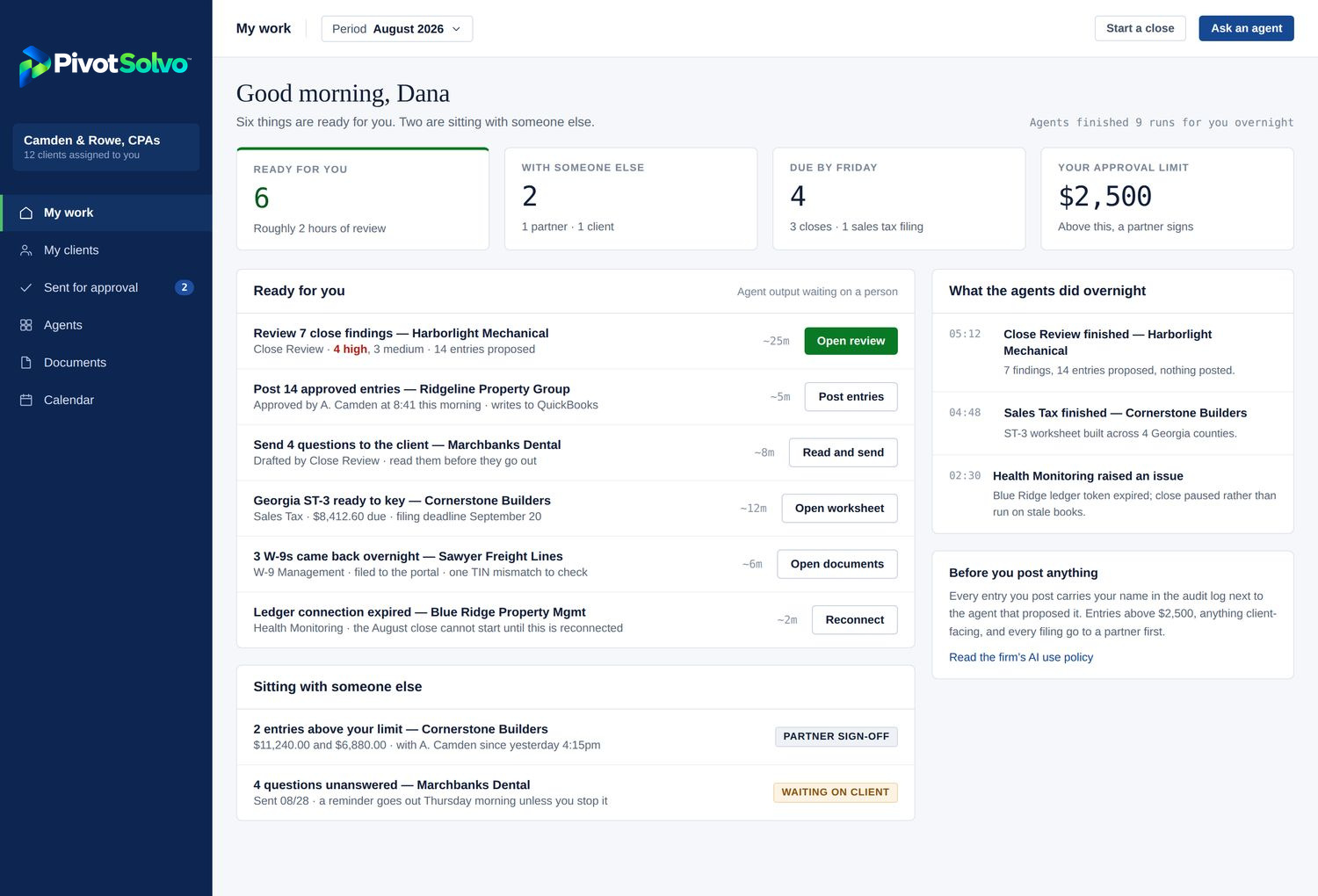
What changes on a Monday
Founding firms
PivotSolvo is not open for general sign-up, and there is no self-serve trial. A small number of firms are being onboarded personally ahead of general availability, and we would rather do four of those properly than forty badly.
What your book looks like, what is eating your review hours, and which agents would actually matter to you. If the answer is that PivotSolvo is not ready for what you need, we will tell you that here rather than six weeks in.
We work through your client list with you — entity types, tax basis, fiscal year ends, accounting system, filing obligations, which clients are consistently painful and why. That intake is what the agents run on.
Materiality, variance thresholds, approval limits by role, escalation cadence, which client requests auto-accept and which wait for a person. Defaults exist; they are yours to change.
The first month runs alongside how you work today, not instead of it, so you see the findings against work you already trust. This is where firms decide whether they believe it.
For partners, staff and whoever will actually be in the software daily. Onboarding and training are part of the setup, not a line item discovered later.
Under your branding, at your pace, starting with the clients who will find it easiest.
How subscriptions are shaped
We are not publishing prices while founding-firm pricing is still being set, and we would rather leave the number out than put up one we intend to change. The shape, though, is settled, and it is worth knowing before you talk to us:
| Element | How it works |
|---|---|
| One-time setup | Covers onboarding and training. Paid once, at the start. |
| Base platform fee | A monthly fee per firm, whatever size you are. |
| Client bands | The subscription scales with how many clients you run through it — bands rather than a per-client meter, so the bill does not move every month. |
| Modules | You subscribe to the agent modules you want. The ones you do not want are not switched on and not billed. |
| Seats | Included by band rather than sold per user. We do not want a firm rationing logins to save money — that is how a platform quietly stops being used. |
| Client portal users | Unlimited, and never charged for. Put every client on it. |
| Term | Month-to-month, or annual at a discount. Your choice. |
| Billing | One invoice a month, drafted from your client count and approved by a person before it is charged. Payment is by bank draft or card on the 1st. |
| Support | Included through your first year. |
One thing we will not offer, now or later: a reseller or referral tier where a firm repackages PivotSolvo and sells it on. White-labeling is for your own clients, under your own name — not for building someone else's product on top of ours.
Straight answers
Most of the client-facing and workflow layer: the client portal, document management and chasing, in-platform messaging, scheduling and meeting booking, e-signature, depreciation and loan and lease schedules, the deadline tracker, sales tax preparation, time and billing, and the practice dashboard. What it does not replace is your general ledger — QuickBooks Online stays — and your tax preparation software. Bring your list to the conversation and we will go through it line by line rather than guessing.
No, and we would rather you did not. Firms typically start with the close and the portal, because those are where the pain is and where clients notice the difference. The rest gets switched on as your existing subscriptions come up for renewal, which is also the honest way to find out whether PivotSolvo is actually replacing them.
No. Nothing is filed or transmitted to a government authority automatically, and that is a hard rule rather than a current limitation. A tax module is on the roadmap; the filing step will still belong to a person.
Yes, for most of the platform. The close, the schedules, the portal, document chasing, compliance tracking, the calendar, cash forecasting and decision support are all open to you. What is gated is the work that is restricted practice — tax planning, tax research, cost segregation, return work and valuation — and that gate is about the person, not the firm. If you have a CPA, an EA or an attorney on staff or supervising who will sign that work, those agents open up. Tell us your situation and we will be straight with you about which parts you would actually get.
Not yet, and we will not imply otherwise. It is on the roadmap and it is dated: a SOC 2 Type II examination, Security and Confidentiality scope, with the observation window planned to open at the end of 2026. We skipped Type I on purpose — a point-in-time letter would not tell you anything useful. The security section sets out exactly what is true today and what is not.
No. Services such as e-signature or card payments connect under your firm's own account, so you keep the contract, the billing and the relationship. PivotSolvo never holds your clients' money.
QuickBooks Online today. Others are designed and sequenced, deliberately behind the work that helps firms on QuickBooks Online now. If you are on something else, tell us — we will say honestly whether you should wait.
No. Every entry is a proposal until a named person at your firm approves it individually. There is no bulk approve, and adding one has been explicitly ruled out in our own build documentation.
Only what a named person at your firm has released. No proposed entries, no exceptions, no internal status vocabulary. The portal has no concept of a pending item because pending items never reach it.
The portal and all client-facing output carry your firm's branding, not ours. Separately, we think material AI involvement should be disclosed to clients through the engagement letter and cover letters — see disclosure. Those two things are not in conflict: the work is your firm's, and the client should know how it is done.
You export everything, whenever you want, without asking us first. Data portability is built in.
PivotSolvo is a product of Pivot Practice Technologies, LLC, a Georgia limited liability company. It is built and run by practicing accountants, and every agent on the roster exists because a real close needed it.
Early access
Tell us your firm, roughly how many clients you run, what you keep the books in, and what is taking the most review time right now. We will tell you honestly whether PivotSolvo helps yet.
Or write to support@pivotsolvo.app directly.