Close review, schedules, sales tax, payroll compliance, document chasing, scheduling, e-signature and the client portal — the subscriptions you buy separately today, as one roster of specialist agents working on one shared client record, with a named person at your firm deciding what goes out.
Why we built it
Most firms can get the work prepared. What they cannot get is enough senior hours to review it. Preparation can be delegated, outsourced, offshored, automated. Review cannot — it is the part your name is on.
So the constraint on a firm's capacity is the number of hours a senior person can spend looking carefully at work someone else did. Every hour of that spent re-adding a bank rec or hunting a duplicate payment is an hour not spent on judgment.
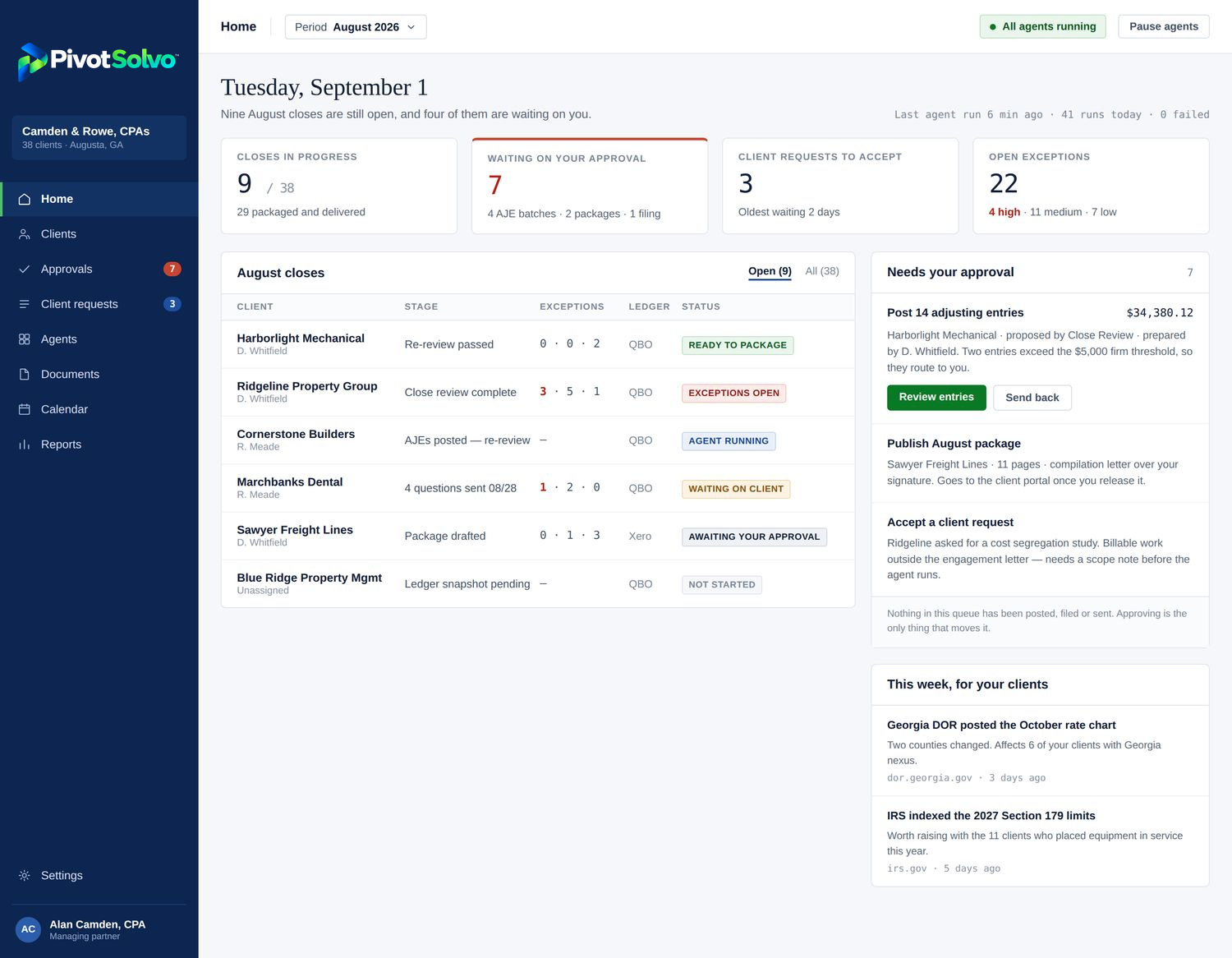
PivotSolvo attacks that hour directly. The agents do the mechanical pass — every account, every period, the same way every time — and hand the reviewer a short list of findings with the evidence already attached. The reviewer still decides. They just start much further along.
All in one
Count what a small firm pays for separately: a client portal, a document manager, a chase tool, a scheduler, an e-signature service, depreciation software, a loan and lease schedule tool, a sales tax service, a deadline tracker, a practice-management dashboard, a messaging tool, time and billing. Twelve logins, twelve invoices, twelve versions of the truth — and none of them share a queue.
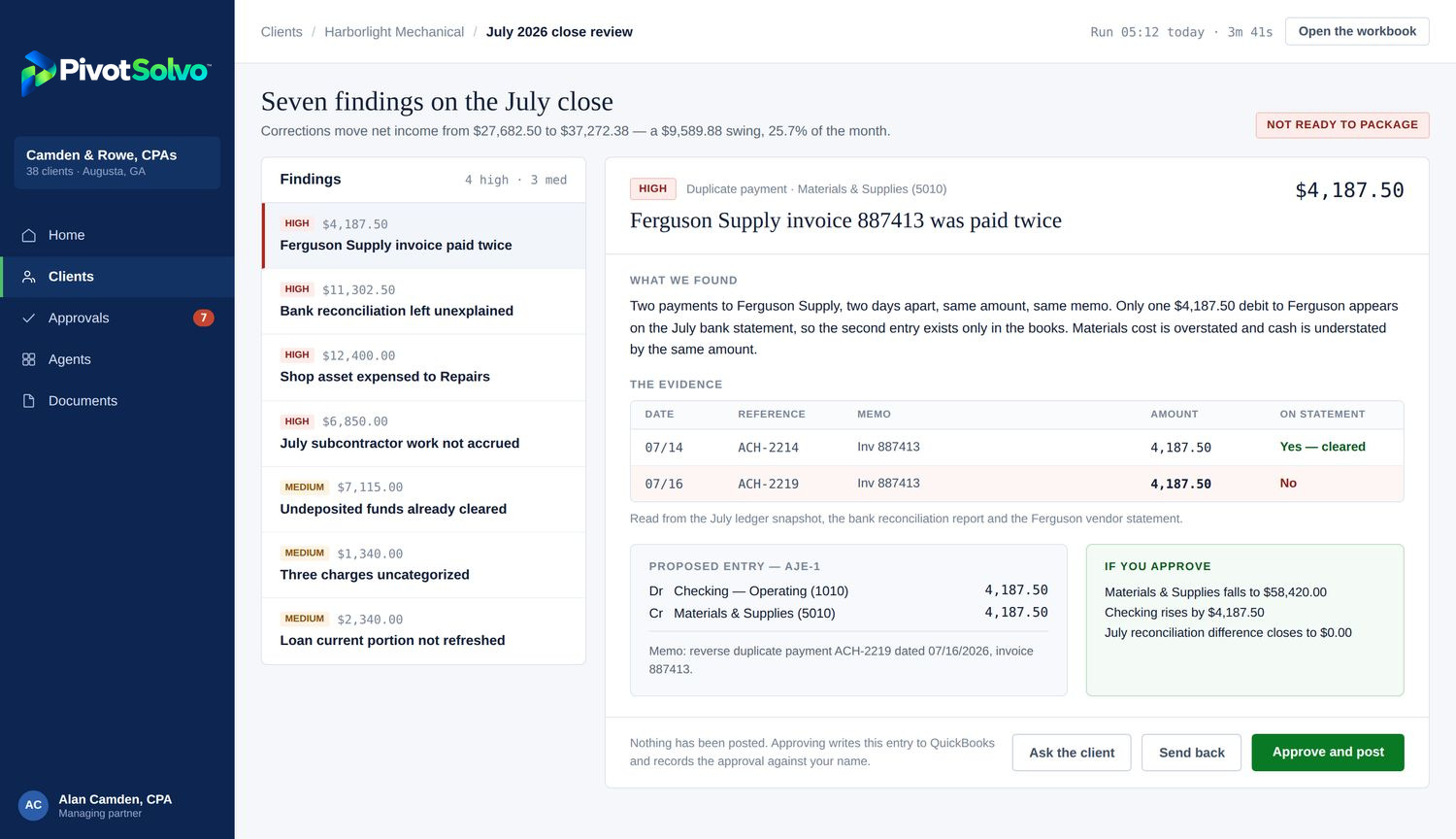
PivotSolvo's agents are separate specialists, but they read the same ledger snapshot, write to the same approval queue and log to the same audit trail. The fixed asset agent's find becomes the document agent's chase becomes the close review's finding, without anyone re-keying it.
Partners, staff and every client in one place, with roles and approval limits that mean something — instead of a spreadsheet tracking who has access to which of the twelve tools.
Subscriptions that arrive on different dates, renew on different terms and never get properly reviewed are how a small firm's software spend quietly doubles.
A finding, the document that proves it, the question that went to the client, the answer, the approval and the entry — one chain, one audit trail, one place to look.
Two things PivotSolvo is not trying to replace: your general ledger — QuickBooks Online stays exactly where it is — and your tax preparation software. Everything else on that list is in scope.
The monthly close run end to end: reconciliations, tie-outs, variance work, proposed adjusting entries, the review workbook and the client-ready financial package.
Fixed assets and depreciation, intangibles, loans and amortization, leases under ASC 842, prepaids and deferred revenue — generated, monitored and kept current.
Sales tax and economic nexus, payroll deadlines and classification, W-9 collection, engagement and filing deadlines across entity types.
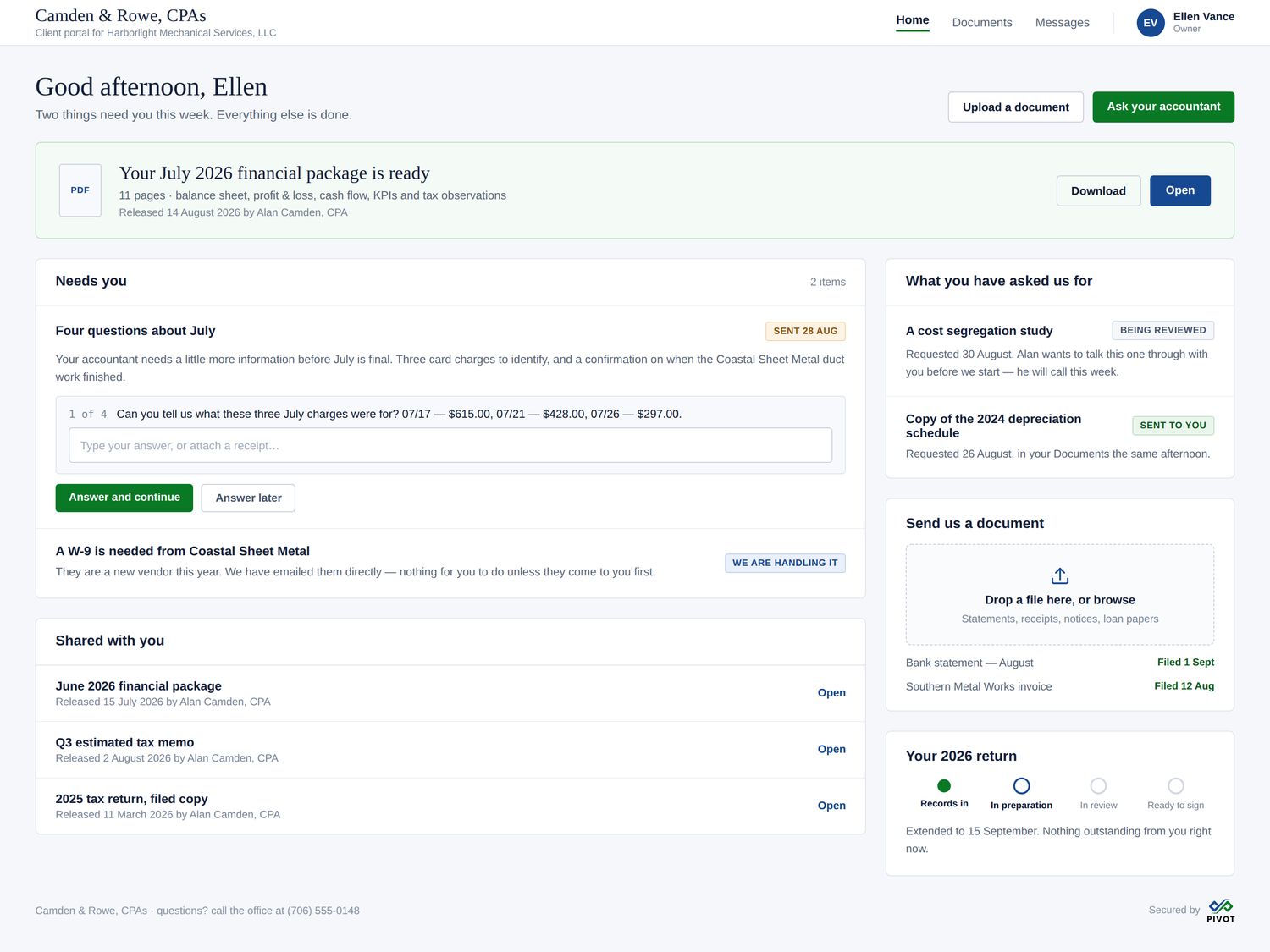
Documents, messages, requests and meeting booking — one place a client goes, where everything they see was released by a named person at your firm.
Calendar and scheduling, inbox triage, time and billing, per-tenant health monitoring, quality management under SQMS No. 1, and your own staff — onboarding, SOPs, training records, CPE and coverage.
Cash forecasting, budgets, tax planning, business valuation and exit planning, decision support, cost segregation, and tax research from an agency-source allow-list.
Collections, the firm's own subscriptions and books, a practice dashboard, and training and help inside the platform.
Your ledger, e-signature and payment services connect under your firm's own accounts. You can disconnect any of them at any time.
The design decision everything else follows from
Two gates sit in the middle of the platform, and nothing crosses them on its own.
No proposed entry, no draft statement, no message and no number crosses to the client side until a named person at the firm releases it. The client portal has no concept of a pending item, because pending items never get there.
Client requests land in the firm's queue. Someone at the firm accepts with a scope note before any work begins. Cheap, bounded items — booking a meeting, say — auto-accept against a monthly cap the firm sets.
Read once and shared by every agent, so the accounting system is not queried twenty-three times for the same numbers.
Each agent looks only at what it is scoped to see, with the firm's own thresholds applied.
Not a conclusion — the underlying transactions, the source document, and the entry that would fix it.
Approve, send back, or ask the client. Your firm defines who that is and up to what amount — a partner, a CPA, the owner of a bookkeeping practice, a senior on their own limit. Nothing is posted, sent or released before this step, and no step batches around it.
Against the named person who approved it, into the accounting system, then read back to confirm it landed.
Snapshot, proposal, review note, approver, write, verification. That record is the answer to "how would you defend this in a peer review."
The client side
Documents, statements, questions, signatures and meeting booking, in a portal that carries the subscribing firm's branding rather than ours. White-labeling is built in, for every firm on the platform.
Who is building this
PivotSolvo is built inside a working accounting practice, by practicing accountants. Every agent on the roster exists because a real close, on a real client, needed it — and each one was tested against work the firm had already done by hand before it was allowed near a client.
Software people build what they imagine an accountant needs. We built what we needed, then found out other firms needed the same thing.
What this is not
Firms hear "AI" and hear headcount, and that is fair — plenty of products in this category do make that pitch. PivotSolvo's is the opposite one. The constraint on a small firm has never been bodies; it is senior review hours. And the work PivotSolvo takes off the desk is the mechanical pass nobody wanted to do in the first place.
Every consequential judgment still belongs to a person, and the platform is built so it cannot be otherwise. There is no faster path that removes the reviewer.
What comes back is capacity — advisory conversations, more clients per senior reviewer, closes that finish before the middle of the following month. Not a smaller payroll.
A second-year who spends the year on judgment instead of tick-and-tie is a second-year who is still there in year three. In this market that is not a soft benefit.
Work smarter, not harder — and let the people you already have do the part only they can do.
Where we stand
You are going to ask this in due diligence, so we would rather answer it here.
A separate database per subscribing firm with row-level security inside it, encryption in transit and at rest, credentials in a managed key vault, and an append-only log of every action on the platform.
There is no SOC 2 report today, and we will not imply there is one. It is on the roadmap: a Type II examination, Security and Confidentiality scope, with the observation window planned to open at the end of 2026. We skipped Type I deliberately — a point-in-time letter would not tell you anything useful.
A full export whenever you want it, without a support ticket. Client-facing output carries your branding, not ours. Your client data is never used to demonstrate the platform to anyone else.
Early access
PivotSolvo is not open for general sign-up. We are onboarding a small number of firms ahead of general availability, each one set up and trained by us directly, so the platform is shaped by real firms before it is opened up. If that is interesting, write to us and tell us about your book.